SFMTA board poised to approve another fare increase
December 19, 2025
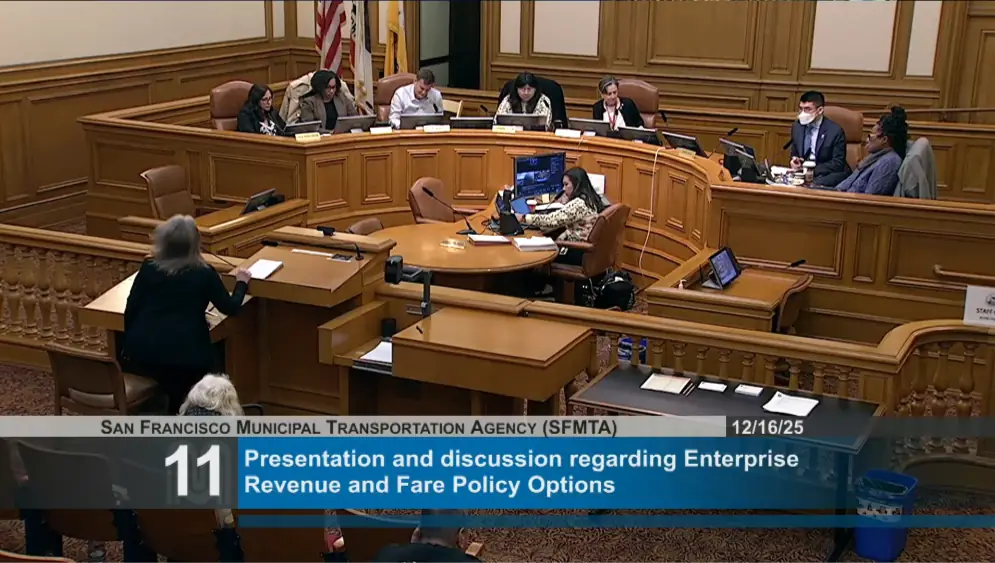
On Tuesday, SFMTA staff revealed revenue proposals that include raising the Clipper fare again — it just went up earlier this year — from $2.85 to $3.00. While other aspects looked somewhat better, the overall picture was that of an agency staff and board alarmingly out of touch with transit riders, placing Muni’s ridership, reputation, and political support at needless risk.
The board, which is entirely appointed by the mayor, expressed no concerns about the fare increase’s impact on struggling working-class transit riders, travel mode decisions, or the public image of their agency that depends on voters passing two critical funding measures next year.
On the contrary, the board’s chair Janet Tarlov praised the fare increase. Echoing staff, Chair Tarlov framed the fare increase as “eliminating the Clipper discount.” Now that Clipper card adoption is widespread, the logic went, the entire point of charging lower fares for Clipper than cash is no longer relevant. Any other possible benefit of keeping fares affordable was ignored.
Streets for All SF, an advocacy group close to Mayor Lurie, was ready to go with an Instagram post praising the likely fare increase as “good news,” calling it “realigning fares…to generate new revenue” in a slide with a big heart emoji superimposed. They set the post to the song “Thankful” by Christian music artist Forrest Frank.
Free interagency transfers to be lost
As far as I can tell, at $3.00, San Francisco would have the highest local bus fare in the country, tied with only a handful of other exceptionally expensive systems like Seattle, HART in Florida, and New York City buses as of this coming January.1 It would also compromise the just-launched free transfers between Muni and BART with Clipper 2.0.
New interagency transfer discounts are funded by an MTC pilot program that covers up to $2.85, which is currently the maximum local bus fare in the Bay Area. Taking a Muni bus or train to your BART train has just become free. It’s a wonderful selling point for public transit, and a rare bright spot in a bad funding environment.
But if this board has its way, it won’t last. With only the first $2.85 covered, the transfer would cost $0.15. That’s still a significant discount, but there’s an enormous psychological difference between “free” and “not free.” No one likes being nickel-and-dimed.
Staff and the board did not even mention this impact at the hearing.
Fare discounts OK for now, but implicitly threatened; car discounts secure
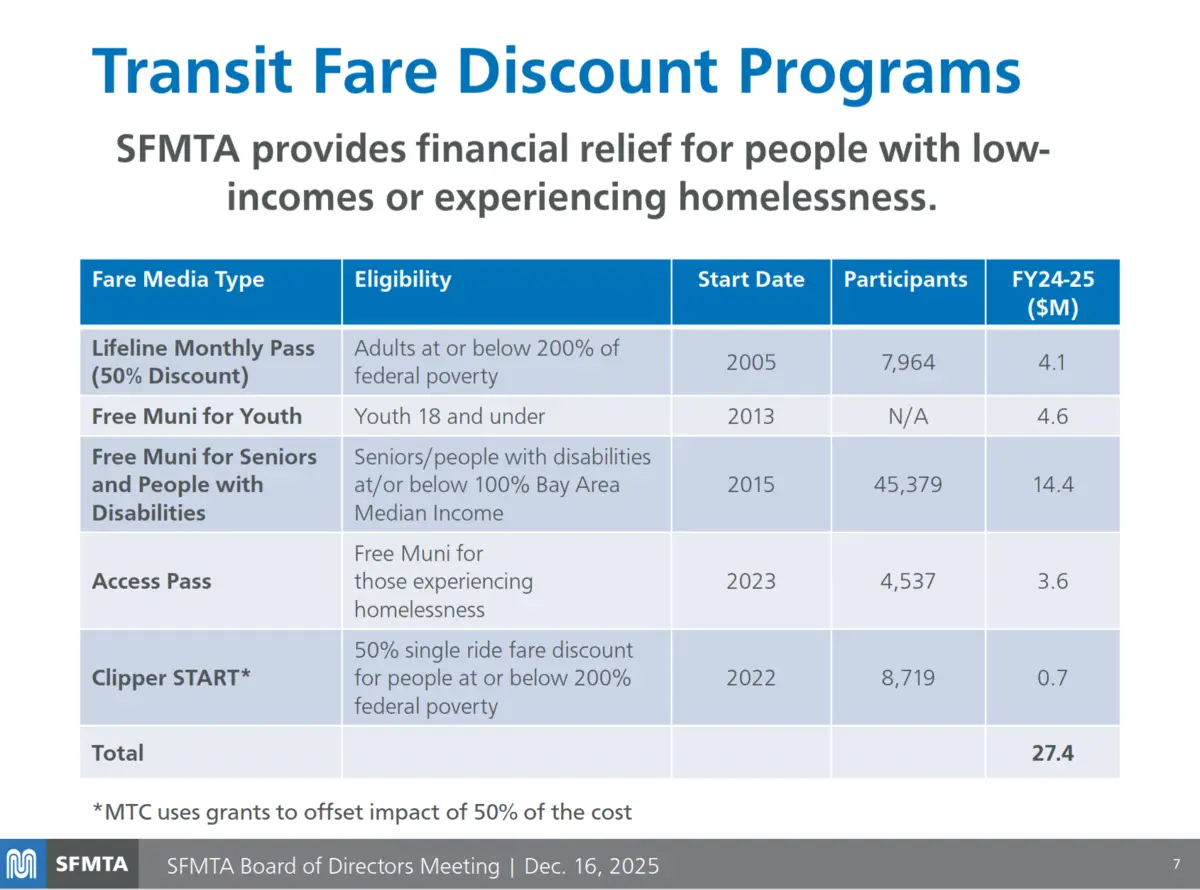
In more “good news” highlighted by Streets for All SF, discounted and free fare programs are proposed to continue as they are, rather than being rolled back.
Compared to the alternative, this is genuinely good! But the staff presentation pointedly listed out the cost of these programs in an unsubtle signal that if budgets get tighter, they could be the first to go. “As you can see,” the presenter said, “the programs do come at a cost… we estimate about $27.4 million a year goes to the administrative costs and also the projected fare revenue reduction.”
I was eager to see if a similar statement would be made about the parking discount program of shutting off meters every evening at 6pm and on Sundays. It was not. Those parking discounts apparently come at no cost, or none that the agency wants us to think about. The slides recommend “No expansion of parking meter hours in [sic] evenings or Sundays,” and omit any dollar amount for this recommendation.
In 2023, a more forthcoming SFMTA estimated revenue from evening and Sunday meters at $18 million. That was only the tip of the iceberg of parking subsidies. Many commercial areas lack meters at all. In the northeastern corner of the Mission District, amid AI boom–induced “parking chaos,” SFMTA suspended plans to roll out meters because of one single community meeting where a few people yelled at them.2 SFMTA could also roll out citywide residential parking permits at any time, but insists on maintaining free parking across most residential areas. The agency has never estimated the full cost of these parking subsidies. It’s safe to say their sum would totally dwarf the meager $27.4 million that helps people afford Muni.
In absolute terms, too, $27.4 million on fare discounts is tiny. As my friend Ed Parillon put it, “These are insanely cheap. The city’s budget is $15 billion. Over one of those billions on cops. The whole discourse around Muni is over an amount of money so small that the cops spent it just on overtime fraud.”
Tuesday’s proposals did include modestly raising some meter rates and citation late penalties, while reducing some parking violation fines, which would net out at an additional $11.6 million over two years.
Fare capping; minor pushback on car-centrism
There was some genuine good news as well. First, once Clipper cards are fully upgraded to Clipper 2.0 over the next eight to twelve weeks, it will be possible to implement daily fare capping. However many Muni rides you take in a single day, your total Clipper or credit/debit charge won’t be more than a day pass, equivalent to two rides. This would cost $2.9 million over two years, compared to $12.5 million more that riders would pay due to fare increases. It works out to mitigating 23% of the hit to riders’ wallets (not including another $5.1 million expected to be paid mostly by tourists for an increased cable car fare).
Second, two directors pushed back slightly on inequities between drivers and transit riders. After transit advocate Audrey Liu pointed out in a public comment that the maximum parking fine of $108 was lower than the fare evasion fine of $130,3 Director Mike Chen and Chair Tarlov echoed the critique. Chen noted a motorist can dodge paying a much higher fee than a fare (especially in the case of demand-responsive parking meters downtown) and, if caught, pay a lower fine than a fare dodger.
Staff’s answer was that they want to keep parking fines lower than the maximum fine in the criminal code for a misdemeanor, but they couldn’t really explain why that didn’t apply to fare evasion fines, too. Perhaps the criticism is sinking in, because at the board’s Vision Zero Committee meeting two days later on the 18th, Director of Streets Viktoriya Wise referenced Liu’s, Chen’s and Tarlov’s feedback on fine fairness as something they would take a look at.
In another small bright spot Tuesday, Director Stephanie Cajina asked staff whether they were tracking Oakland’s experiment with Sunday parking meters. They weren’t. Cajina urged staff to at least follow along with the success and impacts of that program, whether they decide to do it here or not. As Oakland’s news release noted, and it’s just as true in SF:
Free Sunday parking has historical ties to outdated blue laws, which prohibited business activities on Sundays to promote rest and religious observance. Today, Sundays are among the busiest days for businesses such as restaurants, shops and entertainment venues. Updating meter hours helps ensure parking is available when demand is the highest, including weekends.
My advice for the board
Muni absolutely depends on two ballot measures passing in November 2026: a five-county sales tax to fund regional transit and, because that alone doesn’t raise enough for Muni, a San Francisco–specific parcel tax. Either of those failing would mean catastrophic service cuts at Muni. That in turn would put near-apocalyptic levels of additional cars on our streets, creating gridlock, killing more pedestrians, cyclists, drivers, and car passengers, and making a joke of both our climate commitments and any hope of downtown economic recovery.
As a director charged with overseeing this agency, your first, second and third highest priority is to prevent that outcome. That means don’t take transit riders for granted.
This year, this board made cuts to six lines serving Market Street, Haight Street, and Golden Gate Park4, all to save $7 million a year the agency could easily have taken from its $140 million rainy day fund. Then, this board sat idle when Mayor Lurie usurped their authority by allowing Waymo, Uber and Lyft onto a car-free section of Market Street newly cleared of much of its bus traffic. The board ignored the public’s pleas to close the loophole and defend the intent of the SFMTA board’s own Better Market legislation.
Now, as we climb onto scaled-back bus lines that have been deprioritized behind luxury single- or zero-occupant cars, they want us to pay more for that privilege. And then we’re supposed to vote to tax ourselves. Twice.
The prevailing wisdom in City Hall seems to be that they have Muni riders in the bag. All you gotta do is avoid angering motorists, but transit riders will vote for funding no matter what, because we have no choice. If there was ever truth to this logic, I’m afraid it’s being stretched to the breaking point.
I have door-knocked, flyered, lit-dropped, and donated to get transit funding measures over the line, including 2022’s Proposition L sales tax renewal and 2024’s Proposition L TNC tax. I’m ready and willing to do it again. But Muni riders do have a limit. People will say, “Why do I have to be taxed more when they just raised my fare?” Not all, but it might be a decisive number. And volunteers like me can’t work miracles.
So, SFMTA board, if you’re listening: Any fare increase, especially a highly visible one to the round number of $3.00, should be put off until after the election, at least. We want to see restored, increased, and prioritized service, not pay more for less. And show us transit riders that motorists are expected to contribute too. They shouldn’t be fined less for dodging payments, or enjoy free evening and Sunday parking while our fares for evening and Sunday bus rides balloon to a record high.
-
Where the mayor-elect is famously working on that. ↩
-
Curious how they don’t give in equally as fast when transit riders complain about fare increases. ↩
-
There seemed to be some confusion at the hearing as to what the current fare evasion fine actually is, but it was agreed to be higher than the maximum parking fine. It was $130 in April according to the Chronicle. ↩
-
In a 4-3 decision where Mayor Lurie’s appointee Alfonso Felder cast the deciding vote in his first-ever board meeting, making it clear the mayor wanted the cuts. ↩
You can follow me on Mastodon or Bluesky, or this blog via RSS.

Comments
With an account on the Fediverse or Mastodon, you can comment by replying to this post. You can use an account on any server, provided it is not blocked by my server for allowing spam or offensive content.